How to Upload a File to Tableau
Are you finding it difficult to connect GitHub to Tableau? Do you experience exhausted after writing countless lines of lawmaking & still not succeeding?
Don't worry, we've got you covered!
This article will answer all your queries. Follow our easy step-by-step guide to help you master the skill of efficiently connecting GitHub to Tableau and performing insightful analysis.
Table of Contents
- What is GitHub?
- What is Tableau?
- Connecting GitHub to Tableau
- Step 1: Extracting Data From GitHub Using Residue API
- Footstep 2: Loading Github Data Into a Data Warehouse or Database
- Stride three: Connecting a Database/Data Warehouse to Tableau
- Decision
What is GitHub?

GitHub is a repository hosting service that provides millions of software developers, a platform to share their code. Information technology lets them collaborate & manage software development projects.
GitHub hosts projects written in various programming languages such equally Php, Python, Java, etc. & most importantly, GitHub keeps track of all the changes fabricated in every iteration by any of the collaborators or admins of the code repositories.
For further data on GitHub, you can check out the official site here.
What is Tableau?

Tableau is a powerful business intelligence tool used to turn raw data into an understandable format. It is a tool popularly used to visualize information and can exist understood even by a non-technical user.
It creates visualizations with the help of dashboards and worksheets, this helps users perform real-time analysis in a very fast and secure manner. It doesn't require any programming skill or technical background to operate it.
For farther data on Tableau, you lot can check out the official site hither.
Hevo Data, a No-Lawmaking Data Pipeline, helps to transfer data from GitHub (Free Data Source) and 100+ sources to your desired data warehouse for free and visualize information technology in Tableau. Hevo is fully-managed and completely automates the process of not only loading data from your desired source but as well enriching the information and transforming it into an analysis-ready form without having to write a unmarried line of lawmaking.
Get Started with Hevo for Complimentary
It provides a consistent & reliable solution to manage data in real-time and always have analysis-ready data in your desired destination. It allows you to focus on fundamental business needs and perform insightful analysis using BI tools such as Tableau and many more than.
Bank check out some amazing features of Hevo:
- Completely Managed Platform:Hevo is fully managed. Y'all need not invest fourth dimension and effort to maintain or monitor the infrastructure involved in executing codes.
- Live Monitoring: Hevo allows you to monitor the data flow and check where your data is at a detail point in time.
- Data Transformation: Information technology provides a elementary interface to perfect, modify, and enrich the information you want to export.
- Secure: Hevo has a fault-tolerant architecture that ensures that the data is handled in a secure, consistent way with zippo information loss.
- Schema Management:Hevo takes away the tedious task of schema direction & automatically detects schema of incoming data and maps it to the destination schema.
- Minimal Learning: Hevo with its uncomplicated and interactive UI, is extremely simple for new customers to work on and perform operations.
Sign up here for a 14-Twenty-four hours Costless Trial!
Prerequisites
- Working noesis of Tableau.
- Tableau installed at the host workstation.
- A GitHub repository.
- A GitHub account.
Connecting GitHub to Tableau
The purpose of connecting whatsoever application with Tableau is to visualize the data for analysis. Tableau requires information to be in an assay-set up format. The best way is to create a database or use an existing data warehouse, upload information to it, & then connect information technology with Tableau for data assay.
Tableau provides good flexibility and easily connects with a large diversity of data warehouses. Its characteristic of locally caching information to process the queries faster makes the process of handling slow databases a lot easier.
There are many data warehouses such as Google BigQuery, PostgreSQL, Amazon Redshift, etc. with which GitHub can connect in just a few steps. All data warehouses have their set of procedures to fix upwards a successful connection.
You tin connect GitHub to Tableau using the post-obit steps:
- Pace 1: Extracting Data From GitHub Using Rest API
- Step 2: Loading Github Data Into a Data Warehouse or Database
- Pace iii: Connecting a Database/Information Warehouse to Tableau
Step one: Extracting Data From Github Using Residual API
GitHub has a REST API that tin can be used to call up information about projects, repositories, pull requests, and simply about every other kind of information that it stores. For instance, to get data about an upshot, you would make the telephone call as follows:
Get /repos/:owner/:repo/problems/:number Once you have issued the phone call, you would go an output every bit follows:
{ "id": 1, "node_id": "ASD51DGGYH", "url": "https://api.github.com/repo/xxxxxxxx", "repository_url": "https://api.github.com/repos/octocat/abc", "labels_url": "https://api.github.com/repos/octocat/abc/problems/1/labels{/name}", "comments_url": "https://api.github.com/repos/octocat/abc/issues/one/comments", "events_url": "https://api.github.com/repos/octocat/abc/problems/one/events", "html_url": "https://github.com/octocat/abc/issues/i", "number": 13, "state": "open", "title": "Found a bug", "body": "I'g having an issue.", "user": { "login": "oasd", "id": ane, "node_id": "MDdcsawNlcjE=", "avatar_url": "https://github.com/images/error/ocy.gif", "gravatar_id": "", "url": "https://api.github.com/users/octocat", "html_url": "https://github.com/octocat", "followers_url": "https://api.github.com/users/octocat/followers", "following_url": "https://api.github.com/users/octocat/following{/other_user}", "gists_url": "https://api.github.com/users/octocat/gists{/gist_id}", "starred_url": "https://api.github.com/users/octocat/starred{/possessor}{/repo}", "subscriptions_url": "https://api.github.com/users/octocat/subscriptions", "organizations_url": "https://api.github.com/users/octocat/orgs", "repos_url": "https://api.github.com/users/octocat/repos", "events_url": "https://api.github.com/users/octocat/events{/privacy}", "received_events_url": "https://api.github.com/users/octocat/received_events", "type": "User", "site_admin": false }, "labels": [ ], This is how yous tin extract data from GitHub using its Residuum API.
Step ii: Loading Github Data Into a Data Warehouse or Database
Once you have extracted data from GitHub, you need to select the desired destination to load this data and then connect information technology with Tableau to perform information analysis. Every database or data warehouse has its ain ready of steps that demand to be carried out to connect successfully with Tableau.
If you've selected Google BigQuery as your destination, data can be loaded using the bq-control. This command also ensures that the schema & type information is correct. You can read more about loading information using this control and its limitations from the official documentation for Google BigQuery.
Similarly, PostgreSQL offers various methods to upload data depending upon the quantity of data. Insert & copy commands are used to load data in PostgreSQL. The insert control is useful for loading data in smaller chunks whereas, for bulk uploads, the copy command is the better choice. For further information on loading data into PostgreSQL, you can bank check the official documentation of PostgreSQL.
There are many data-warehouses such as Snowflake, Amazon Redshift, etc. that y'all choose every bit your desired destination and load your GitHub information to connect with Tableau.
This is how you tin load data from GitHub to your desired information warehouse or database.
Stride 3: Connecting a Database/Data Warehouse to Tableau
Launch Tableau on your workstation and select more from the connect cavalcade on the left. This will open a new window, from where you can select your desired data warehouse or database.
You can fifty-fifty choose the ODBC option if y'all want to connect using the ODBC connector of a item database or information warehouse.
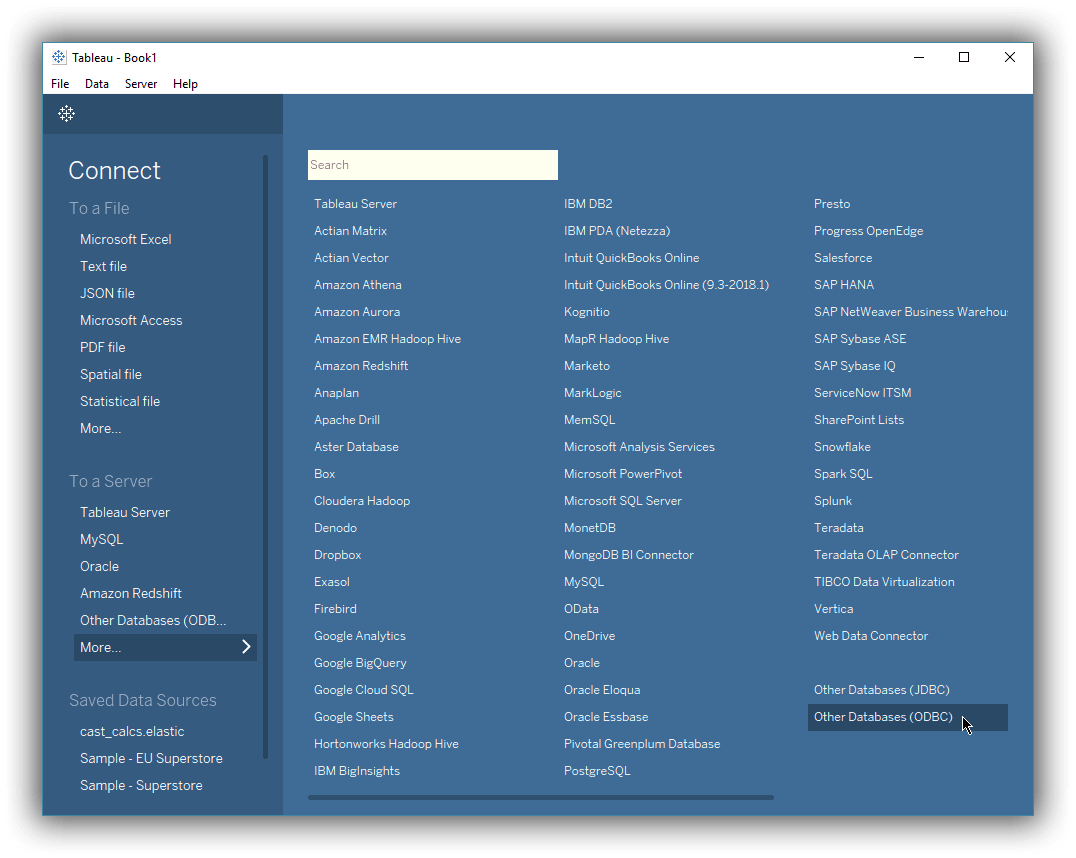
To connect with Tableau, you need to provide the credentials for your desired database or information warehouse such every bit your username, password, server, port number, etc. to successfully connect and load information into Tableau.
For case, if you select Amazon Redshift as your data warehouse, you will come across the following connection dialog box on your screen once you've selected it.
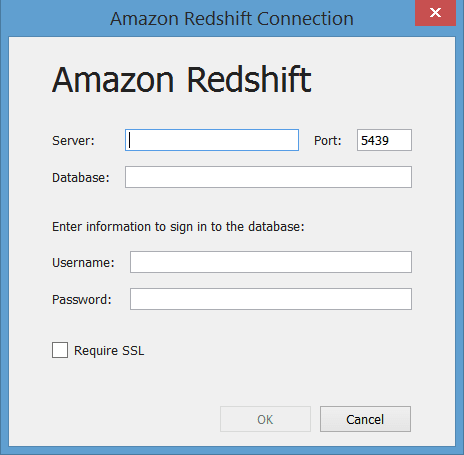
This is how yous tin connect GitHub to Tableau by first loading your Github data into a desired database or information warehouse and and then connecting it with Tableau.
Decision
This article teaches you how to transfer information from GitHub to Tableau. Information technology also provides in-depth knowledge about the concepts behind every step to aid y'all understand and implement them efficiently. Using APIs and executing ETL jobs tin can exist challenging, especially for a beginner & this is where Hevo saves the day.
Hevo Information, a No-Code Information Pipeline, helps you transfer data from GitHub (Gratis Data Source) to a destination of your choice in a fully-automated and secure manner without having to write the code repeatedly for free. Hevo with its potent integration with 100+ sources & BI tools, allows you to not only export & load data only also transform & enrich your data & make it analysis-fix in a jiffy.
Visit our Website to Explore Hevo
Want to accept Hevo for a spin? Sign Upwards and feel the feature-rich Hevo suite first hand.
Tell us nearly your feel connecting GitHub to Tableau! Share your thoughts with us in the comments section below.
Source: https://hevodata.com/learn/connect-github-to-tableau/

Postar um comentário for "How to Upload a File to Tableau"